

There are several excellent books on the urgent need for universal basic income in the US. They include ones by Andrew Yang, Amy Lowrey, and Andy Stern. Stern is a long-time union organizer and past president of the Service Employees International Union (SEIU). He is credited with growing that union by over 1.2 million members. In 2010 he stepped down as head of the SEIU and in 2016 published a book on universal basic income, “Raising the Floor,” which inspired Andrew Yang’s UBI-centered primary campaign.
Stern’s book is a tour de force based on his observations on the changing work landscape in the US and around the world. After a visit to MIT’s “Media Lab,” Stern speculates that we are at an “inflection point”; technology will displace the need for human labor at an increasing, possibly exponential, rate. That in turn will drive the further rise of gig and contingent work, the subject of today’s post.
Perhaps the best way to quantify the change in the labor landscape is to talk about the number of workers who do not earn a living as long-term permanent employees. That includes temporary workers, gig workers, contractors, and others whose jobs are not assured by employment contracts. By this measure, about 30 to 40 percent of the US workforce is contingent and growing.
Nor is this uniquely American. Stern notes that worldwide, roughly three-quarters of workers are employed in temporary jobs, short-term contracts, or informal work without permanent employment.
Stern points out that this is the historical norm:
The job market as we know it—the one that evolved in the early 20th century—depended on two factors: a strong nation state that could enforce economic policies, and strong unions that could organize entire companies and industries and negotiate for higher wages and benefits. Before that, the relationship between employers and employees was one sided and feudal, with the owners having all the rights and workers doing piece work jobs to cobble together a meager and uncertain living indeed the majority of Americans worked in crafts and trades and had multiple sources of income.
Stern goes on to note that “work” and “job” are again no longer synonymous.
Is this a good thing or a bad thing? Some well-paid contractors will do just fine until technology comes for them the way AI has for programmers, but in general contingent workers earn less, don’t have benefits, and have little security or opportunity for growth. Stern cites many such cases in his chapter on “The Dark Side of the Gig Economy.” Gig work sites such as Upwork and Amazon Mechanical Turk are open to the world with US workers competing with workers from lower-wage countries. US labor laws do not apply to these workers or indeed domestic workers such as janitors and Uber drivers who are classified as independent contractors.
Rather than trying to recreate the labor market of the past, it makes more sense to adapt our social contract to the economy that is emerging.
Social Security already follows the individual rather than being tied to employment. Health insurance should too. More broadly, many of the benefits we now associate with permanent employment should instead belong to people, regardless of where—or whether—they work. Some projections suggest that as many as half of all workers could be contingent by mid-century.
Moving these benefits into the social contract could actually strengthen traditional employment. Today employers can save money on benefits and payroll taxes by replacing permanent employees with contractors. If health insurance and other basic protections followed the worker instead of the job, that cost advantage would largely disappear. Businesses would be more likely to hire permanent employees whenever long-term staffing made sense.
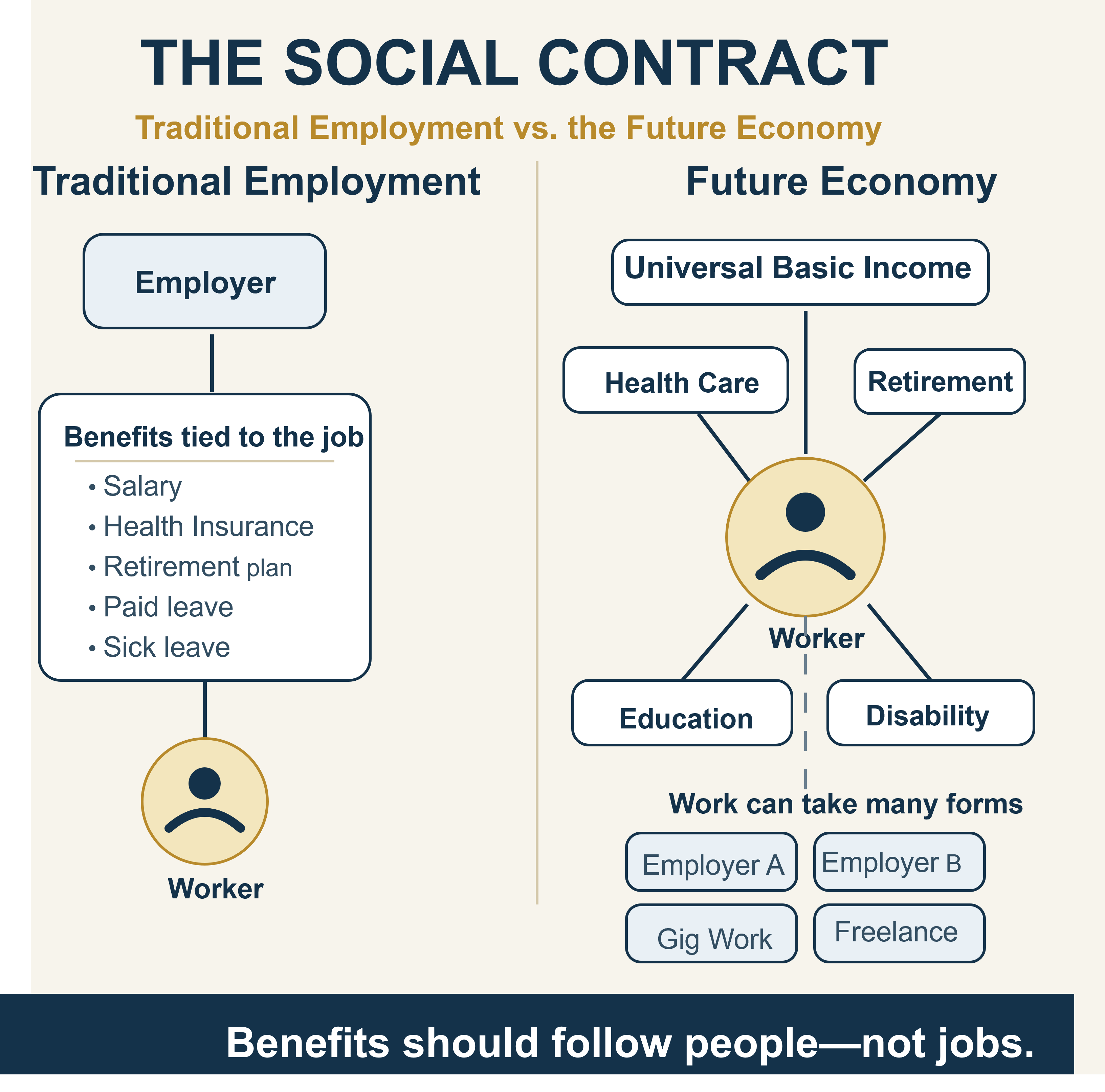
How does universal basic income fit into this mix? Moving benefits into the social contract is necessary, but is not adequate to address the problem of employment and wages. Contingent workers really have no bargaining power unless unionized. As technology reduces the demand for labor, wages will continue to fall relative to the growth of the economy. Income inequality will continue to grow. Returns to capital (stock dividends, etc.) will grab an increasingly large slice of national income. As this column and my book, Shares in America, have discussed at length, only large income transfers will let workers share the benefits of economic growth. Technology is good: we produce more with less labor. But we need to realize that labor will, for the indefinite future, be in excess supply and deal with that reality.
I’m enthusiastic about the future. The promise of technology has never been simply that it allows us to produce more. Its real promise is that it can give us more time and greater freedom: more time with our families, more opportunities to learn, create, volunteer, start businesses, care for loved ones, and participate in our communities.
If you’re a supporter of universal basic income, please sign on here. Only a grass roots movement will get us there!